
Inside Our Peterborough Workshop — How We Build Every Bossway Campervan
Inside Our Peterborough Workshop — How We Build Every Bossway Campervan
Every Bossway Motorhomes campervan starts as an empty panel van and is transformed, by hand, into a fully equipped luxury campervan at our workshop in Peterborough.
Where we build: Peterborough, Cambridgeshire
Bossway Motorhomes is based at 7 Dodson Way, Fengate, Peterborough PE1 5XJ — a purpose-designed workshop facility in the East Midlands. Peterborough is well located for customers travelling from across the UK: we are close to the A1 and A47, and five minutes from Peterborough railway station, which has direct services from London King’s Cross, Edinburgh, Birmingham and most major UK cities. We welcome customers to visit the workshop at any point — whether you are still deciding, actively configuring your specification, or coming to see your build in progress. We operate Monday to Friday 9:00am–5:30pm and Saturday 10:00am–4:00pm.
Stage 1: Base vehicle selection and preparation
All Bossway campervan conversions are built on the Fiat Ducato — sourced to a consistent specification: current model year, low mileage, with the full Fiat manufacturer warranty intact. Before conversion work begins, the base vehicle undergoes a detailed inspection of the van’s mechanical and electrical systems, full underseal treatment, and removal of any original internal panels or fittings from the cargo area.
Stage 2: Insulation
Insulation is one of the most important and least visible stages of a quality campervan conversion. Poor insulation leads to condensation, damp, noise and heat loss — all expensive and difficult to rectify once furniture is installed. Bossway uses a combination of closed-cell spray foam (for structural sections and wheel arches), rigid insulation board (for flat panels) and acoustic deadening material applied to the van’s metalwork before insulation begins. The insulated shell is then lined with a breathable membrane. The result is a van that is genuinely quiet on the road, warm in winter and cool in summer.
Stage 3: Electrical system installation
The electrical system is installed before furniture, allowing all cables to be routed cleanly through the vehicle structure. Every Bossway electrical system includes the leisure battery bank (lithium in the Horizon and Adventure, AGM in the Origin), the battery-to-battery charger that recharges the leisure bank from the Fiat’s alternator while driving, solar panels and MPPT controller, the inverter for 230v output, shore power connection and circuit protection throughout. All cables are correctly sized. All circuits are individually fused. All connections are properly terminated. The completed electrical system is tested and documented before furniture installation begins.
Stage 4: Furniture design and manufacture
Bossway designs all campervan furniture in-house using CAD software and 3D scanning of the van interior, ensuring furniture fits the precise interior dimensions of each van length — L2, L3 or L4 — rather than using generic modules adapted to fit. Furniture is manufactured from lightweight composite boards — typically aluminium honeycomb panels — CNC-routed for precision, then hand-finished, edged and assembled. Worktops are solid surface or granite effect. Hinges, drawer runners and fittings are selected for durability and smooth operation.
Stage 5: Plumbing and water systems
Every Bossway campervan has a full fresh water and waste water system. Fresh water is stored in a dedicated tank and supplied via an electric pump to the kitchen sink, washroom basin and shower. Water heating is provided by a compact water heater integrated into the system. Waste water is collected in a grey water tank. All water fittings are push-fit or properly soldered. All tanks are properly supported and ventilated. The system is pressure-tested and run before final handover.
Stage 6: Final fit-out and upholstery
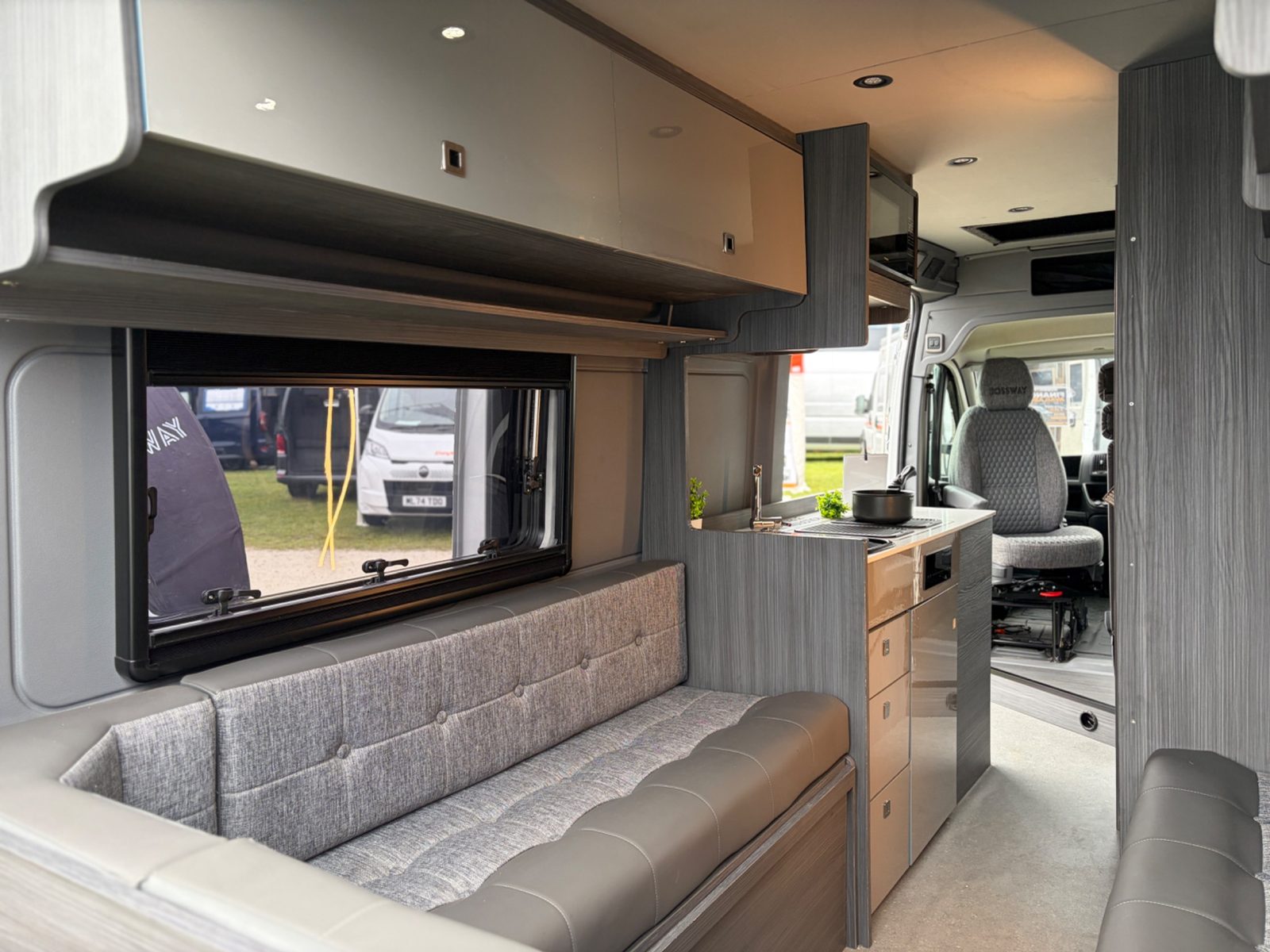
The final fit-out includes installation of appliances (hob, fridge, microwave if specified), window blinds and flyscreens, the heating system and its ducting, and upholstery of all seating, bed bases and headlining. Bossway uses premium upholstery fabrics across all models. Seat cushions are made to a comfortable depth with high-density foam. Customers can discuss upholstery options during the specification process.
Stage 7: Quality control and pre-delivery inspection
Before any Bossway campervan is handed over, it goes through a full pre-delivery inspection covering all electrical systems (tested under load), all water systems (run for a full cycle), all mechanical systems, exterior paint or wrap finish, and all interior furniture and fittings. The specification document for that vehicle is checked against the completed build. Any item not meeting our standards is addressed before handover.
Come and see it for yourself
The best way to understand what a Bossway campervan conversion is — and what distinguishes it — is to visit the workshop in Peterborough. You can see a build in progress, inspect the materials and engineering, and discuss your specification with the people who will actually build your campervan.
Book a visit to our Peterborough workshop, call 01733 609930, or start your configuration online. We are at 7 Dodson Way, Peterborough PE1 5XJ — five minutes from Peterborough station, close to the A1 and A47.
Ready to choose your Bossway campervan?
Call 01733 609930, visit the Bossway workshop at 7 Dodson Way, Peterborough — or configure your campervan online.
Campervan Finance in the UK — What You Need to Know Before You Buy
Campervan Finance in the UK — What You Need to Know Before You Buy
Financing a campervan in the UK works differently to car finance. The amounts involved are larger, the terms are longer, and the lenders are typically specialists in leisure vehicles rather than mainstream car finance providers.
This guide explains how campervan finance works in the UK, what affects your APR, how deposit requirements work, and what to think about when financing a bespoke panel van campervan conversion.
How does campervan finance work in the UK?
Campervan finance in the UK is typically arranged through a specialist leisure vehicle lender as an introduction from the manufacturer. The most common structure for a bespoke campervan purchase is a hire purchase agreement (HP): you pay a deposit (typically 20% or more), the lender pays the balance to the manufacturer on your behalf, you make fixed monthly payments over the agreed term, and you own the vehicle outright once the final payment is made.
What deposit do I need for campervan finance?
For a premium campervan finance agreement in the UK, a deposit of at least 20% of the vehicle price is typically required. For a Bossway Horizon at £79,990, that represents approximately £16,000 as a minimum deposit. A larger deposit reduces the amount financed and your monthly payment. If you have an existing vehicle to part-exchange, that value can be used as all or part of your deposit.
How long can campervan finance be spread over?
Campervan finance terms in the UK can range from 12 months to 15 years (180 months). Most buyers choose terms between 5 and 10 years. Illustrative monthly payments on a Bossway Horizon at £79,990 with 20% deposit and 9.9% representative APR: approximately £1,360/month over 5 years, £1,040/month over 7 years, £800/month over 10 years, or £620/month over 15 years. Use the Bossway finance calculator for an accurate estimate at any price, deposit and term.
What APR should I expect for campervan finance?
Bossway Motorhomes’ representative APR is 9.9%. Representative APR means at least 51% of customers who apply receive the advertised rate. The actual rate offered to you will depend on your credit profile, income, the amount financed and the lender used. Finance is subject to status, affordability assessment and lender approval. Bossway will introduce you to a suitable lender as part of the purchase process — no commitment is required to explore a finance quote.
Can I finance a bespoke campervan conversion?
Yes. Finance is available on all Bossway Motorhomes campervan conversions, including fully bespoke builds ordered through the configurator. Finance for a bespoke build is typically arranged once the full specification is agreed and a build slot is confirmed. A deposit is usually required to secure the build slot, with the finance arranged ahead of the completion date.
What affects whether my campervan finance is approved?
Key factors include: your credit history (a history of on-time payments improves your chances and can secure a lower rate), income and affordability (lenders assess whether the monthly payment is manageable given your income and existing commitments), deposit size (a larger deposit reduces the lender’s exposure and can improve your chances and the rate offered), and employment status (lenders want to see evidence of stable, regular income).
Is campervan finance better than a personal loan?
For most buyers, specialist leisure vehicle finance is more appropriate than a standard personal loan. Personal loans are typically capped at £25,000–£50,000 and at terms up to 7–10 years — for a £79,990 campervan this would require either a very large deposit or a very high monthly payment. Specialist leisure finance is designed for these amounts and can offer longer terms that keep monthly payments manageable.
Use the Bossway finance calculator to explore monthly payments. To discuss a personalised finance quote, contact the Bossway team or call 01733 609930. Finance is subject to status, affordability and lender approval. Bossway Motorhomes introduces customers to specialist leisure vehicle lenders and is not a lender or credit broker.
Ready to choose your Bossway campervan?
Call 01733 609930, visit the Bossway workshop at 7 Dodson Way, Peterborough — or configure your campervan online.
What Is a Panel Van Campervan Conversion and What Does It Include?

What Is a Panel Van Campervan Conversion and What Does It Include?
A panel van campervan conversion is a standard commercial van — most commonly a Fiat Ducato, Ford Transit or Mercedes Sprinter — that has been professionally converted into a fully-equipped campervan by a specialist manufacturer.
The process involves removing the commercial interior, insulating the shell, and building a complete living space including kitchen, sleeping, washroom and power systems inside the van’s body. The result is a vehicle that looks similar to the original van on the outside — though usually with paint, graphics or wrapping — but is completely transformed inside.
Panel van campervan vs. factory-built motorhome: what is the difference?
A factory-built motorhome is produced in volume with standardised specifications and sold through dealer networks. A panel van campervan conversion keeps the original van body, which is typically stronger, better-sealed and more aerodynamic than an extended coachbuilt body. It drives more like a car with better visibility, smaller external dimensions and easier parking. The conversion can be tailored to the buyer’s specification in a way that production-line vehicles cannot. Panel vans are available in multiple lengths — L1, L2, L3 and L4 — giving flexibility in overall size.
What does a professional panel van campervan conversion include?
The base vehicle
All Bossway campervans are built on the Fiat Ducato, available in L2, L3 and L4 body lengths — approximately 5.4 metres, 6.0 metres and 6.4 metres respectively.
Insulation and shell preparation
Before any furniture is installed, the van shell is professionally insulated with closed-cell spray foam (for structural sections and wheel arches), rigid insulation board (for flat panels) and acoustic deadening material. The insulated shell is then lined with a breathable membrane that allows any incidental moisture to move away from the metalwork. Proper insulation is one of the most critical and least visible aspects of a quality conversion.
Kitchen
A fully fitted kitchen is standard in all Bossway conversions, including a hob (induction in the Horizon, gas in the Origin and Adventure), a stainless steel sink with pump tap, a compressor fridge and solid surface or granite effect worktops.
Sleeping and lounge
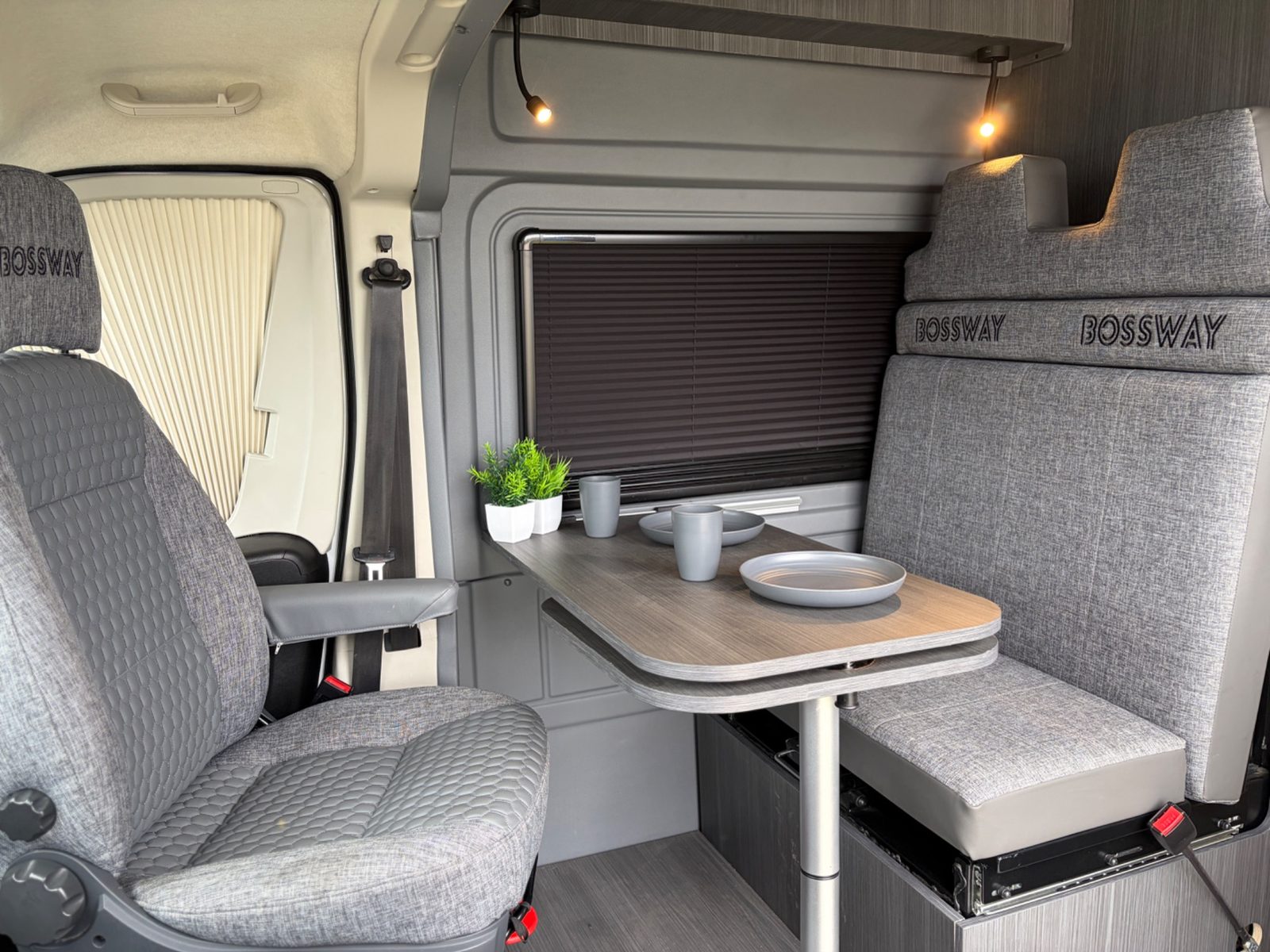
Bossway campervans are available as 2, 3 or 5 berth across all models and lengths. Options include fixed rock-and-roll beds, drop-down beds, fold-flat dining tables and pop-top roof conversions that add sleeping space above the main living area.
Washroom
A self-contained washroom with shower, toilet and hand basin is included or available on all Bossway conversions, fully plumbed with a fresh water tank, waste water tank, water heater and electric pump.
Electrical system
Bossway conversions include a leisure battery system, battery-to-battery charger, solar panel and MPPT controller for off-grid charging, shore power connection, 230v inverter and full circuit protection. All wiring is properly sized, fused and documented.
Heating
The Origin uses a diesel air heater with ducted outlets. The Horizon uses 12v infrared heating — a gas-free system with no combustion products. The Adventure includes diesel heating with off-grid specification options.
Pop top roof
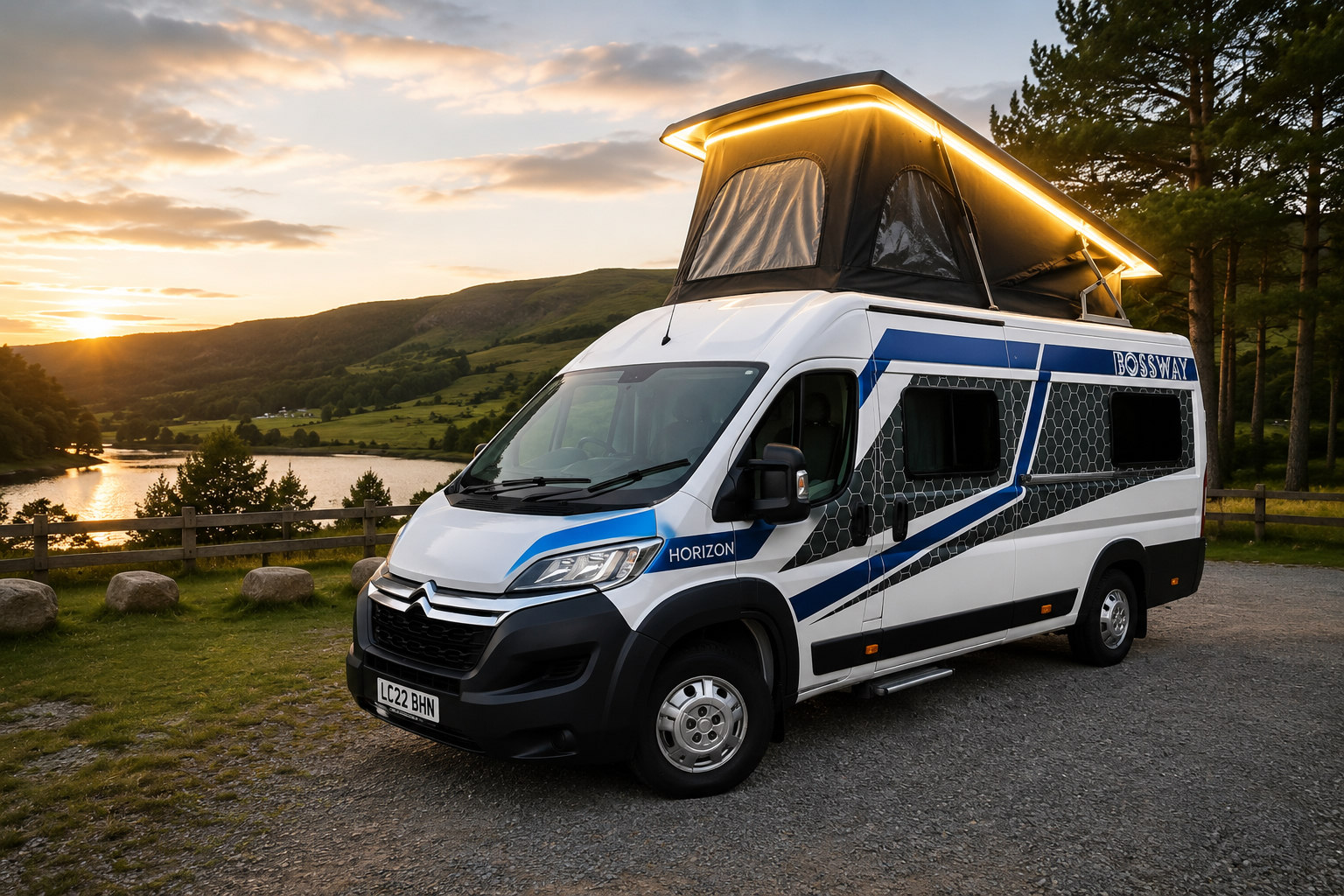
An optional pop top is available across all Bossway models and lengths, adding standing room when parked and an elevated sleeping area without extending the van’s overall length or changing its road profile.
Choosing a panel van length for your conversion
L2 (approximately 5.4 metres): Most manoeuvrable and easiest to park. Suitable for 2–3 berths. Ideal for couples and solo travellers who want a compact, car-like driving experience. L3 (approximately 6.0 metres): The most popular length. Space for a proper washroom, full kitchen and 3–5 berths without being difficult to manoeuvre. L4 (approximately 6.4 metres): The most generous interior with room for up to 5 berths. Still significantly more manageable than a coachbuilt motorhome of similar internal volume.
How to choose a panel van campervan manufacturer in the UK
Look for an accessible workshop you can visit at any point, transparent pricing with a clear specification list, a properly documented electrical system, furniture built from lightweight non-MDF materials designed for vehicle use, a manufacturer warranty on the conversion work alongside the base vehicle warranty, and real completed builds you can inspect in person.
Bossway Motorhomes builds panel van campervan conversions at our Peterborough workshop. Contact us to discuss your specification, view campervans available now, or use the configurator to start designing your Bossway.
Ready to choose your Bossway campervan?
Call 01733 609930, visit the Bossway workshop at 7 Dodson Way, Peterborough — or configure your campervan online.
How Much Does a Campervan Conversion Cost in the UK? (2026 Guide)
How Much Does a Campervan Conversion Cost in the UK? (2026 Guide)
The question most people ask before they buy a campervan is a simple one: how much does a campervan conversion actually cost?
It is also one of the hardest questions to answer clearly, because “campervan conversion” covers an enormous range of outcomes — from a DIY weekend project costing a few thousand pounds to a professionally built, fully equipped panel van campervan with luxury interior, off-grid power and a warranty, costing £70,000 or more.
This guide explains what you are actually buying at different price points, what drives the cost of a professionally built campervan conversion in the UK, and what to expect if you are spending £65,000–£95,000 with a specialist manufacturer like Bossway Motorhomes.
DIY campervan conversion costs (£5,000–£30,000)
At the lowest end, buyers purchase a used panel van — typically a Fiat Ducato, Ford Transit or Volkswagen Crafter — and convert it themselves, buying materials and fitting everything independently.
A basic DIY conversion with insulation, a simple kitchen unit, a fixed bed and basic 12v electrics can be done for £5,000–£15,000 in materials. Add solar, a lithium battery bank, a proper washroom and quality furniture, and the materials bill rises to £15,000–£30,000.
The hidden cost of DIY is time. A thorough campervan conversion takes most non-professional builders 300–600 hours — six to twelve full working weeks. Many DIY projects take 12–18 months from start to finish. A professionally built conversion by a known UK manufacturer will also hold its value significantly better than a DIY build, however carefully done.
Entry-level professional campervan conversions (£30,000–£55,000)
At this price point, buyers are typically purchasing a van converted to a fairly standard specification — often with lower-grade furniture, basic 12v electrics and limited customisation — or a used professionally built campervan from the secondary market.
Mid-range professional campervan conversions (£55,000–£69,000)
This is where materials quality and engineering start to reflect a genuinely well-built campervan. At this price point you can expect a newer base vehicle, proper thermal and acoustic insulation, a fitted kitchen, fixed or drop-down bed options, a basic 12v electrical system, a shower room or toilet cubicle and central heating. Finish quality can vary significantly between converters — it is worth visiting any converter’s workshop before committing at this price point.
Premium campervan conversions (£65,000–£95,000)
This is the segment Bossway Motorhomes operates in. At this price point, the difference compared to mid-range is significant and immediately visible in person. A premium panel van campervan conversion at £65,000–£95,000 includes a current-generation base vehicle with full manufacturer warranty, CNC-routed lightweight furniture with no chipboard or MDF, solid surface or granite effect worktops, induction or gas hob, a properly engineered 12v and 230v electrical system with lithium battery bank, a proper washroom with shower tray, toilet and hand basin, diesel or 12v infrared heating, premium upholstery and a pop top or fixed roof at the buyer’s choice.
What drives the cost of a professional campervan conversion?
The base vehicle. A new Fiat Ducato L3 costs £35,000–£45,000 before conversion begins — typically the single largest cost component. The interior furniture. Professional-grade lightweight furniture accounts for £8,000–£18,000 in a high-spec build. The electrical system. A well-engineered off-grid system — lithium battery bank, inverter, solar, MPPT controller, shore power and circuit protection — costs £3,000–£8,000 in parts alone. The washroom. A proper shower room adds £2,000–£5,000 to the build cost. Heating. A diesel heating system is £1,500–£3,000 installed. Labour. A premium conversion takes 300–500 hours of skilled labour, representing £15,000–£30,000 in build time alone.
Is a professional campervan conversion worth the cost?
For buyers spending £65,000–£95,000, the professional route makes sense for several reasons: quality engineering and materials designed to last the life of the vehicle; a manufacturer warranty; better resale value with documented specification and clear ownership history; and a clear build timeline measured in weeks, not the 12–18 months many DIY builds take.
How much does a Bossway campervan conversion cost?
Bossway Motorhomes panel van campervan conversions start at £69,990 for the Origin. The Horizon starts from £79,990 and the Adventure from £89,990. Prices vary by specification, length (L2, L3 or L4) and options. Finance is available across all models, with terms from 3 to 15 years and a minimum 20% deposit at 9.9% representative APR.
Use the Bossway finance calculator to explore monthly payments. View campervans available now or contact us to discuss a new build.
Ready to choose your Bossway campervan?
Call 01733 609930, visit the Bossway workshop at 7 Dodson Way, Peterborough — or configure your campervan online.
What to Ask When Buying a Campervan
What to Ask When Buying a Campervan
Buying a campervan is a significant purchase — typically between £30,000 and £95,000 depending on the build standard. These are the questions every buyer should ask before committing, whether they are looking at a new manufacturer build or a used vehicle.
Questions about the base vehicle
What is the mileage? What is the service history? Has it had any accident damage? What is the current MOT status? For a new conversion, ask what age and specification of base vehicle is being used — a new or nearly-new van is a significant part of what you are paying for.
Questions about the conversion quality
Who did the conversion? Is there a paper trail? What insulation has been used and where? How is the furniture fixed — mechanically fastened or adhesive? What electrical cabling standard has been used? Is the gas system certificated? These questions separate premium conversions from budget builds quickly.
Questions about the electrical system
What is the leisure battery capacity and type — AGM or lithium? What solar panel output is fitted? Is there an MPPT controller? How does the battery charge from the alternator? Is there a mains shore power inlet? Can the system support an induction hob? These details determine real-world off-grid capability.
Questions about finance
If you are using finance to purchase, ask about APR, deposit requirements, total amount repayable and what happens if you want to settle early. For Bossway campervans, finance is available from 9.9% APR with a 20% minimum deposit and terms up to 15 years, subject to status.
Questions to ask Bossway
We welcome detailed questions. Can I visit the workshop? Can I see a build in progress? Can I compare L3 and L4 side by side? What is the current build slot availability? What is included in the price? These are exactly the conversations we have with customers every week — call 01733 609930 or visit us in Peterborough.
Ready to choose your Bossway campervan?
Call 01733 609930, visit the Bossway workshop at 7 Dodson Way, Peterborough — or configure your campervan online.
Campervan Insurance in the UK: What You Need to Know
Campervan Insurance in the UK: What You Need to Know
Insuring a campervan conversion is different from insuring a standard car or a coachbuilt motorhome. Getting the right policy from the start matters — both for protecting your investment and for making sure you are properly covered in the event of a claim.
What type of insurance do you need for a campervan?
A converted panel van can be insured as a campervan, a motor caravan or, in some cases, as a commercial vehicle. The policy type you use should reflect how you use the vehicle. A specialist campervan insurer (rather than a standard car insurer) is usually the right choice for a premium conversion — they understand the valuation, the fixtures and the risks involved.
Agreed value vs market value policies
An agreed value policy settles at a pre-agreed figure in the event of a total loss — important when your campervan has significant conversion value that would not be captured in a standard book valuation. For a new Bossway campervan costing £65,000–£95,000, an agreed value policy is strongly recommended. Market value policies often settle for less than the vehicle is worth to you.
What affects the cost of campervan insurance?
Key factors include: vehicle value, annual mileage, where you store the vehicle, your claims history, how many months of the year you plan to tour and whether you ever sleep abroad. Specialist insurers offer tailored policies for regular tourers, seasonal users and those who wild camp.
Popular UK campervan insurance providers
Specialist campervan insurers in the UK include Comfort Insurance, Safeguard, Adrian Flux, Brentacre and Leisuredays. Comparison sites do not always include the best specialist options — calling a specialist broker directly is often worth the extra few minutes.
Does Bossway advise on insurance?
Bossway does not sell or arrange insurance, but we can point customers toward the right specialist insurers for a new conversion. Call 01733 609930 or ask when you visit the workshop.
Ready to choose your Bossway campervan?
Call 01733 609930, visit the Bossway workshop at 7 Dodson Way, Peterborough — or configure your campervan online.
Best Campervan Touring Destinations in the UK

Best Campervan Touring Destinations in the UK
The UK is one of the best campervan touring countries in the world. With diverse landscapes, wild camping opportunities in Scotland, established campsites in England and Wales, and coastal routes in every direction, a well-specified campervan opens up a huge amount of the country.
Scottish Highlands
Scotland is the best destination in the UK for wild camping, with legal right to camp on most unenclosed land. The NC500 (North Coast 500) has become one of the most popular campervan routes in Europe — winding around the northern coast through Torridon, Durness, Thurso and back via Inverness. Wild camping spots are plentiful. A diesel heater and good sleeping insulation are important for Scottish touring in any season.
Lake District
The Lake District National Park has excellent campsites, dramatic scenery and roads that test any driver — which makes a compact van conversion a practical choice. Coniston, Ullswater, Ambleside and Keswick are popular bases. Booking campsites in advance is essential in high season.
Cornwall and the South West
The South West is the UK’s most popular campervan destination in summer. Coastal routes, surf beaches, cliff-top campsites and village pubs make it ideal for family touring. The Lizard Peninsula, Land’s End, Dartmoor and Exmoor each offer a different character. Off-season touring (April, May, September, October) gives the same scenery with fewer crowds.
Wales
Wales offers some of the best value and least crowded touring in the UK. The Pembrokeshire Coast, Snowdonia (now Eryri), Brecon Beacons and the Gower Peninsula each deserve multiple days. Welsh campsites tend to be well maintained and reasonably priced.
Which Bossway model is best for UK touring?
All three Bossway models are well suited to UK touring. The Origin and Horizon are popular for the South West and Wales. The Adventure is particularly well regarded for Scotland and more rugged destinations where off-grid systems and a distinctive exterior make sense. Call 01733 609930 to discuss which model suits your plans.
Ready to choose your Bossway campervan?
Call 01733 609930, visit the Bossway workshop at 7 Dodson Way, Peterborough — or configure your campervan online.
Part Exchange Your Campervan, Motorhome or Van
Part Exchange Your Campervan, Motorhome or Van
Part exchange allows you to offset the value of your current vehicle against the cost of a new Bossway campervan. Bossway accepts part exchange on qualifying campervans, motorhomes and vans — and the process is straightforward.
What does Bossway accept in part exchange?
We primarily consider campervans and motorhomes, but also consider panel vans in good condition. The key factors are age, mileage, service history, condition and current market value. We consider each vehicle individually rather than applying a blanket policy.
How to value your part exchange
Before submitting your vehicle for assessment, it helps to know its approximate retail value and realistic trade value. Check similar vehicles on AutoTrader, CampervanFinder and eBay to understand the market. Be honest about condition — an accurate assessment from you means a more accurate valuation from us.
How does the part exchange process work with Bossway?
Submit your vehicle details through our part exchange form — including photos, current mileage, service history and any known issues. We will review the submission and come back to you with an indication of what we can offer against a Bossway build. No obligation to proceed at that stage.
Can part exchange fund the full cost of a new Bossway?
Rarely entirely, but it can significantly reduce the amount you need to finance. If your part exchange covers a meaningful deposit, it can also reduce monthly payments on the remaining amount. Finance is available from 9.9% APR with a minimum 20% deposit and terms up to 15 years, subject to status.
Ready to choose your Bossway campervan?
Call 01733 609930, visit the Bossway workshop at 7 Dodson Way, Peterborough — or configure your campervan online.
Campervan Heating Options: Diesel, Gas and Electric
Campervan Heating Options: Diesel, Gas and Electric
Keeping warm in a campervan overnight requires a proper heating system — not a consumer fan heater. The main options for UK campervan conversions are diesel heating, LPG gas heating and electric heating, each with different advantages and trade-offs.
Diesel heaters
Diesel heaters (like Webasto and Eberspächer) draw diesel from the vehicle’s main tank and produce high-output hot air or hot water heating. They are efficient, reliable and widely used in premium campervan conversions. They work without shore power or a large battery bank and are well suited to UK touring including wild camping and winter use. Bossway campervans can be specified with diesel heating.
Gas heating
LPG gas heaters use bottled gas stored in the van. They are effective but require gas storage, gas plumbing and careful ventilation. Many converted van owners move away from gas over time for ease of touring — you need to carry and refill gas cylinders.
Electric heating
Electric heating (blown air, panel heaters or underfloor systems) requires a significant battery bank and/or shore power. Pure electric heating is less common in off-grid campervan conversions because of the battery drain. When combined with a large lithium bank and solar, it can work for mild conditions.
What does Bossway recommend?
For UK touring — including autumn and spring camping — diesel heating is the most practical and popular option. It is what Bossway typically includes in builds for customers who want reliable off-grid warmth without depending on site hook-up. Speak to us when configuring your build about heating specification.
Ready to choose your Bossway campervan?
Call 01733 609930, visit the Bossway workshop at 7 Dodson Way, Peterborough — or configure your campervan online.
Campervan Lithium Battery vs AGM: Which Should You Choose?
Campervan Lithium Battery vs AGM: Which Should You Choose?
Your campervan leisure battery is one of the most important decisions in an off-grid conversion. The choice between lithium and AGM affects cost, weight, capacity, charging behaviour and how long the system lasts.
AGM batteries: the traditional choice
AGM (Absorbent Glass Mat) batteries are sealed lead-acid batteries that do not require maintenance. They are cheaper than lithium to buy upfront, widely available and suitable for moderate off-grid use. The main limitations are lower usable capacity (typically 50% of rated capacity before damage), heavier weight and shorter cycle life compared to lithium.
Lithium batteries: the modern choice
Lithium iron phosphate (LiFePO4) batteries offer usable capacity of up to 80–90% of their rated capacity, much lower weight, faster charging and a significantly longer cycle life — often 2,000–5,000 cycles versus 300–500 for AGM. The upfront cost is higher but the total cost of ownership over time is often lower.
Which is right for your campervan?
For occasional weekend touring with access to hook-up, AGM can be adequate and saves money upfront. For regular off-grid touring, wild camping, or full-time use, lithium is almost always the better choice once total cost and usable capacity are compared properly. All Bossway campervans can be specified with lithium battery systems.
What else affects your electrical system?
Solar panel output, solar controller type (MPPT is more efficient than PWM), inverter size, charging from the alternator and shore power charger specification all affect how well your system works in practice. Speak to Bossway when configuring your electrical spec — these decisions affect touring experience significantly.
Ready to choose your Bossway campervan?
Call 01733 609930, visit the Bossway workshop at 7 Dodson Way, Peterborough — or configure your campervan online.